
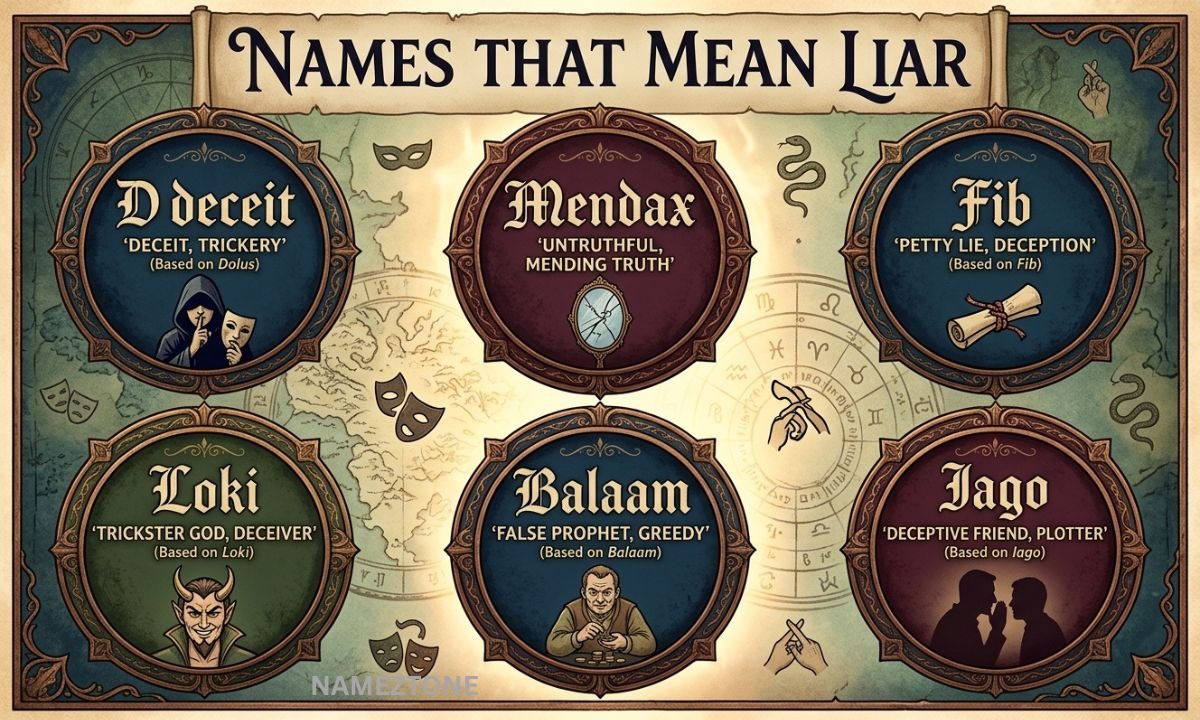
Choosing a baby name is a big decision. Most parents look for names that mean love, strength, or hope. But some names carry darker meanings, and “liar” is one of them.
Names that mean liar are rare and unusual. They come from many cultures and old languages. Some parents pick these names for their unique sound, not for their meaning. Others simply find the history behind them interesting.
In this article, we will share a list of names that mean liar or deceiver. Each name comes with its origin and true meaning. This can help you avoid a name by mistake, or choose one on purpose for its bold, unusual story.
Quick Checklist Before Choosing a Trickster or Liar-Themed Name
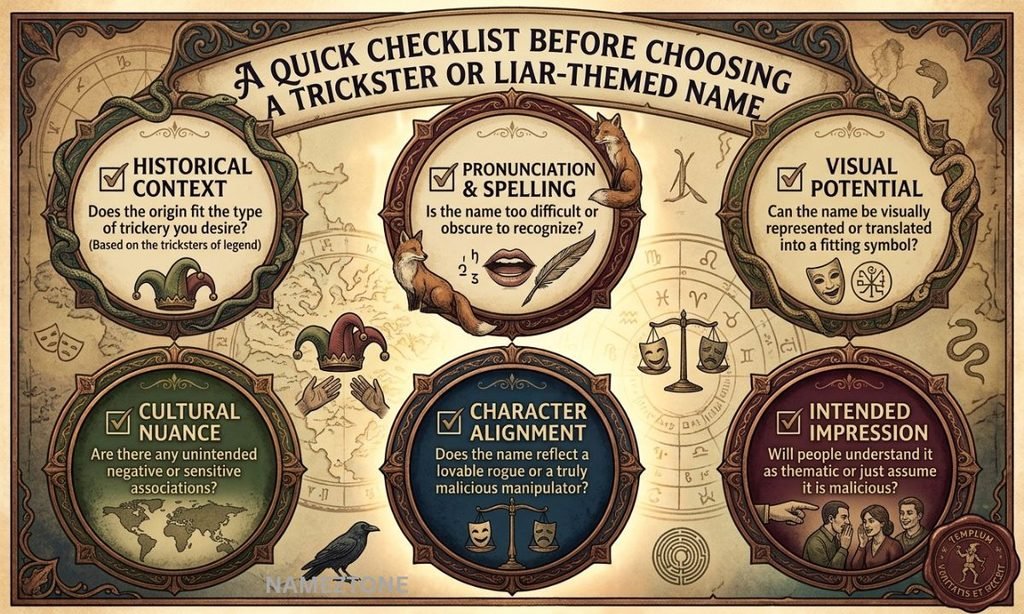
Before you pick a name with a dark or mischievous meaning, take a moment to think it through. A name lasts a lifetime, so it helps to plan ahead.
- Check the pronunciation in your own language and culture
- Look up more than one source for the meaning
- Think about how the name sounds with your last name
- Consider if the “dark” meaning is well known or hidden
- Ask family members for honest feedback
- Think about nicknames the name could create
- Decide if you want the meaning to be literal or just symbolic
Names That Mean Liar Generator
🎭 Names That Mean Liar Generator
Generate mysterious, clever, deceptive, and intriguing names inspired by liars and tricksters.
Names That Mean Liar (Girl)
Girl names tied to lying or deception are rare, since most cultures avoid naming daughters after negative traits. Still, a few names carry this hidden meaning through old myths or word roots. Some parents like these names simply for their sound.
- Ate (Greek myth, goddess of mischief and delusion)
- Apate (Greek, literally means “deceit”)
- Dolores (often linked to sorrow, sometimes tied to trickery in folklore)
- Lyra (poetic link to “lyre,” loosely tied to smooth-talking charm)
- Mayari (Filipino myth, associated with hidden truths)
- Circe (Greek myth, sorceress known for deception)
- Medea (Greek myth, known for cunning and betrayal)
- Scylla (Greek myth, deceptive sea monster)
- Loreen (folk variant tied to “lore” and storytelling)
- Fibber (informal, playful modern coinage)
- Delusia (invented, root “delusion”)
- Wileen (invented, root “wile”)
- Cozenia (invented, root “cozen,” an old word for trick)
- Guilelis (invented, root “guile”)
- Shifta (Amharic-inspired, loosely tied to “shifty”)
- Ilusia (Spanish root “ilusión,” meaning illusion)
- Mendax (Latin, feminine form used loosely, means “lying”)
- Falsia (Latin root “falsus,” meaning false)
- Trixie (English, root “trick”)
- Cressida (Greek/English literature, symbol of broken promises)
Names That Mean Deceiver
These names come from words and roots that directly translate to “one who deceives.” Many are borrowed from Latin, Greek, or old English roots.
- Mendax (Latin, “lying” or “deceiver”)
- Apollyon (Greek, destroyer with deceptive traits in some texts)
- Sly (English, “cunning” or “deceptive”)
- Guile (English, root word for deception)
- Cozen (Old English, means “to deceive”)
- Wily (English, “full of tricks”)
- Falsworth (invented surname-style, root “false”)
- Beguile (English, “to deceive charmingly”)
- Delude (root word, “to mislead”)
- Feign (English, “to pretend”)
- Dissem (short form of “dissemble,” meaning to disguise intent)
- Ruse (French, means “a trick”)
- Cunningham (English surname, root “cunning”)
- Wilehart (invented, “wily heart”)
- Duplex (Latin root, “double,” tied to double-dealing)
- Feint (English, a false or deceptive move)
- Craven (English, tied to cowardice and deceit in old use)
- Trickford (invented surname-style)
- Sham (English, “fake” or “pretend”)
- Bluffton (invented, root “bluff”)
Boy Names That Mean Liar
Boy names linked to lying are more common in mythology and old languages than everyday name lists. Many come from legendary tricksters and clever heroes.
- Loki (Norse myth, god of mischief and lies)
- Sinon (Greek myth, the man who tricked Troy with the wooden horse)
- Proteus (Greek myth, shape-shifter known for evasive answers)
- Hermes (Greek myth, god of thieves and clever speech)
- Reynard (French folklore, the trickster fox)
- Iago (Shakespeare, symbol of manipulation and lies)
- Puck (English folklore, mischievous spirit)
- Coyote (Native American myth, trickster figure)
- Autolycus (Greek myth, master thief and liar)
- Br’er (African-American folklore, trickster rabbit tales)
- Loptr (Old Norse alternate name for Loki)
- Wile E. (pop culture inspired, root “wile”)
- Slick (English, informal, “smoothly deceptive”)
- Foxworth (invented surname-style, tied to fox symbolism)
- Cunningsley (invented, root “cunning”)
- Mendel (sounds close to “mendax,” though true origin is unrelated)
- Falstaff (Shakespeare, known for boastful lies)
- Wily (see above, used for boys too)
- Ravensworth (invented, ravens symbolize trickery in folklore)
- Deceptus (invented Latin-style, root “deceptio”)
Boy Names That Mean Liar or Trickster
This list blends direct meanings with trickster archetypes from world mythology and folklore.
- Loki (Norse)
- Anansi (West African myth, spider trickster)
- Maui (Polynesian myth, clever trickster demigod)
- Kitsune (Japanese folklore, shape-shifting fox spirit)
- Loge (German opera version of Loki)
- Sly (English)
- Renard (French, “fox,” tied to trickster tales)
- Iktomi (Lakota myth, spider trickster)
- Raven (widely used in Native folklore as a trickster)
- Nanabozho (Ojibwe myth, trickster hero)
- Eshu (Yoruba myth, trickster deity)
- Loptur (variant of Loki)
- Vertumnus (Roman myth, shape-shifting deceiver)
- Wiley (English, “full of tricks”)
- Cagliostro (historical con man, Italian)
- Houdini (surname of the famous illusionist, tied to trickery)
- Sinbad (folklore hero known for clever escapes)
- Puckett (surname-style, root “Puck”)
- Foxx (modern spelling, tied to fox symbolism)
- Craft (English, “skillful deception”)
Names That Mean Betrayer
Names tied to betrayal often come from historical figures or literary characters remembered for breaking trust.
- Judas (Biblical, symbol of betrayal)
- Brutus (Roman history, betrayed Julius Caesar)
- Ganelon (medieval French legend, betrayed Roland)
- Ephialtes (Greek history, betrayed the Spartans at Thermopylae)
- Mordred (Arthurian legend, betrayed King Arthur)
- Vidkun (Norwegian, associated with the historical traitor Quisling)
- Delilah (Biblical, associated with betrayal of trust)
- Tarquin (Roman history, tied to betrayal and tyranny)
- Cassius (Roman history, conspirator against Caesar)
- Sejanus (Roman history, betrayed Emperor Tiberius)
- Wormtongue (literary, Tolkien’s betrayer character)
- Loyalless (invented, ironic modern coinage)
- Falseheart (invented, symbolic)
- Turncoat (English term, not typically a name but used symbolically)
- Backstead (invented, root “backstab”)
- Oathbreaker (invented, symbolic compound name)
- Quisling (Norwegian surname, became a term for traitor)
- Renegade (English word, “one who betrays a cause”)
- Doubleman (invented, symbolic)
- Falco (Latin root “falx,” loosely tied to betrayal themes in some tales)
Names That Mean Manipulator
These names lean toward control, persuasion, and subtle influence rather than outright lying.
- Machiavelli (Italian historical figure, symbol of calculated manipulation)
- Iago (Shakespeare, master manipulator)
- Circe (Greek myth, manipulated men through magic)
- Kaa (pop culture, hypnotic manipulator)
- Wormtongue (Tolkien, manipulative advisor)
- Svengali (literary, name became a term for a manipulator)
- Puppeteer (English descriptive term)
- Sway (English word, root meaning “to influence”)
- Persaud (surname-style, root “persuade”)
- Cassius (Roman history, manipulated conspirators)
- Delphine (French, loosely tied to oracle-like persuasion)
- Manoah (Biblical name, unrelated origin but phonetically close to “manipulate”)
- Charmion (Greek, root “charm”)
- Fenwick (invented, symbolic “fen” meaning trickery in old use)
- Wileton (invented, root “wile”)
- Coaxley (invented, root “coax”)
- Cunninger (invented, root “cunning”)
- Handler (English occupational-style surname, symbolic)
- Steerford (invented, symbolic “steer”)
- Pullstrings (invented, symbolic compound)
Names That Mean Secretive
Names in this group are tied to hidden things, secrecy, and quiet concealment.
- Secret (English word used directly as a name in modern times)
- Cryptia (invented, root “crypt,” meaning hidden)
- Arcana (Latin, “secrets” or “mysteries”)
- Nightshade (English, symbolic of hidden danger)
- Veil (English word, symbol of concealment)
- Shadow (English word, widely used symbolically)
- Mira (has multiple meanings across cultures, sometimes tied to hidden wonder)
- Enigma (Greek root, “riddle” or “mystery”)
- Cloak (English word, symbol of hiding)
- Whisper (English word, symbol of quiet secrecy)
- Hushana (invented, root “hush”)
- Discreet (English word, descriptive)
- Concealia (invented, root “conceal”)
- Mysten (invented, root “mystery”)
- Sotto (Italian, “sotto voce” means “under the voice,” or quietly)
- Undertow (English word, symbolic of hidden depth)
- Nightveil (invented compound)
- Reticent (English word, descriptive of quiet secrecy)
- Silentia (Latin root, “silence”)
- Guarda (Italian/Spanish root, “guard” or “watch,” symbolic of protecting secrets)
Names That Mean Schemer
These names focus on planning, plotting, and calculated strategy.
- Machiavel (root of “Machiavellian,” symbol of scheming)
- Plotus (invented, root “plot”)
- Cassius (see above, master schemer in Roman history)
- Ganon (pop culture, scheming villain archetype)
- Scarlet (in some stories tied to scheming femme fatale archetypes)
- Ravana (Hindu epic, cunning schemer in the Ramayana)
- Shakuni (Hindu epic Mahabharata, famous for scheming)
- Grima (Tolkien, schemer advisor)
- Ozai (pop culture, scheming ruler archetype)
- Loki (again fits here, god of schemes)
- Plotter (English descriptive term)
- Weaver (English word, symbolic of “weaving plots”)
- Snidely (pop culture villain name style)
- Cunninplan (invented compound)
- Foxwell (invented, symbolic)
- Stratagem (English word, root meaning “a scheme”)
- Machina (Latin root, “deus ex machina,” symbolic of engineered plots)
- Intrigue (English word used descriptively)
- Contriva (invented, root “contrive”)
- Schemeworth (invented surname-style)
Names That Mean Deception
This group leans on the broad, general idea of deceiving others through words or actions.
- Illusion (English word used symbolically)
- Mirage (French/Arabic root, “an illusion”)
- Deceptia (invented Latin-style)
- Phantom (Greek root, “an illusion or apparition”)
- Chimera (Greek myth, symbol of illusion and impossibility)
- Glamour (old Scottish word, originally meant “a magic spell that deceives the eye”)
- Fatamorgana (Italian, a type of mirage, named after the sorceress Morgana)
- Sham (English word)
- Charade (French, “a pretense”)
- Facade (French, “a false front”)
- Ruse (French)
- Trompe (French, from “trompe-l’oeil,” meaning “deceives the eye”)
- Deceit (English word)
- Masquerade (English/French, “a disguise”)
- Bluff (English word)
- Guiselle (invented, root “guise”)
- Pretendia (invented)
- Feigna (invented, root “feign”)
- Falsetta (invented, root “false”)
- Veneer (English word, “a false surface”)
Names That Mean False Hope
These names are tied to promises that don’t come true, or hope that leads to disappointment.
- Elpis (Greek myth, spirit of hope, sometimes tied to false or misleading hope in the Pandora myth)
- Mirabel (root “mira,” meaning “wonderful,” sometimes tied ironically to false wonder)
- Promessa (Italian/Portuguese root, “promise”)
- Delusory (English word, descriptive)
- Wishara (invented, root “wish”)
- Hopewell (English surname, ironic use here)
- Fauxlyn (invented, root “faux” meaning false)
- Illusoria (invented Latin-style)
- Vainhope (invented compound)
- Chimerin (invented, root “chimera”)
- Dreamless (invented, ironic compound)
- Mirage (see above)
- Wistful (English word, descriptive)
- Deludia (invented)
- Empty Promise (descriptive phrase, not a formal name)
- Hollowbright (invented compound)
- Fadewish (invented compound)
- Sirenlure (invented, tied to sirens’ false promises in Greek myth)
- Tantalus (Greek myth, punished with food and water always out of reach)
- Icarian (Greek myth, tied to Icarus and the false hope of flying too close to the sun)
Dolion Name Meaning
Dolion is an unusual name with roots in ancient Greek. It comes from “dolios,” a word connected to trickery and cunning. In Greek mythology, Dolion appears as a minor figure tied to guile and clever strategy rather than open honesty.
Because of this root, Dolion fits naturally into lists of trickster-themed names. It is not widely used today, which makes it rare and distinctive. Parents drawn to Greek mythology or unique, meaningful names sometimes consider Dolion for its unusual sound and deep backstory.
Japanese Names That Mean Liar
Japanese naming culture rarely uses direct negative meanings like “liar.” Most of the names below draw on words or folklore connected to trickery rather than a literal translation.
- Kitsune (fox spirit known for shape-shifting and trickery)
- Uso (Japanese word meaning “lie,” used here as a name-style entry)
- Tanuki (folklore raccoon dog known for playful deception)
- Bakemono (general term for a shape-shifting trickster spirit)
- Yako (a type of fox spirit in folklore)
- Kaito (common Japanese name; sometimes loosely linked online to trickster themes, though its true meaning is “ocean” or “soar”)
- Ryo (common name; occasionally paired with trickster themes in fan naming lists)
- Shiro Kitsune (“white fox,” a trickster figure in folklore)
- Kokuu (invented, evokes emptiness or hollow words)
- Itsuwari (Japanese word meaning “falsehood”)
Names That Mean Trickster in Japanese
- Kitsune (fox spirit trickster)
- Tanuki (raccoon dog trickster)
- Mujina (badger spirit, sometimes a trickster in folklore)
- Tengu (mountain spirit known for mischief)
- Kappa (river spirit, sometimes mischievous in stories)
- Yokai (general term for supernatural, sometimes trickster-like beings)
- Namazu (giant catfish yokai, tied to mischief in earthquake folklore)
- Zashiki-warashi (playful, mischievous house spirit)
- Nue (chimera-like trickster creature in folklore)
- Bake-danuki (variant term for a shape-shifting trickster raccoon dog)
Last Names That Mean Liar
Surnames with this meaning are uncommon, since most family names come from jobs, places, or ancestry. A few, however, developed meanings tied to deceit through old word roots or nicknames.
- Fox (English, symbol of cunning across many cultures)
- Reynard (French, the legendary trickster fox surname)
- Cunningham (Scottish, root “cunning”)
- Wily (English, descriptive surname)
- Sly (English, descriptive surname)
- Craft (English, root meaning “skill” but historically tied to cunning)
- Guiler (invented surname-style, root “guile”)
- Falconer (English occupational surname, phonetically close to “false” though unrelated in origin)
- Trickett (English surname, coincidentally close to “trick”)
- Cozens (English surname derived from “cousin,” sometimes mistaken for “cozen”)
- Loveless (English surname, sometimes linked ironically in folk etymology to broken promises)
- Sharper (English, historical slang for a con artist)
- Bluffton (place-name-style surname)
- Feint (invented surname-style)
- Falsworth (invented)
- Deceptor (invented, modern coinage)
- Mendacci (invented, Italian-style root “mendax”)
- Wilehart (invented)
- Ravensworth (invented)
- Shiftley (invented, root “shifty”)
Mythological & Legendary Names Associated with Deception
- Loki (Norse)
- Circe (Greek)
- Medea (Greek)
- Sinon (Greek)
- Proteus (Greek)
- Prometheus (Greek, trickster who deceived the gods with fire)
- Anansi (West African)
- Maui (Polynesian)
- Coyote (Native American)
- Eshu (Yoruba)
- Iktomi (Lakota)
- Nanabozho (Ojibwe)
- Loge (German/Norse variant)
- Apate (Greek, goddess of deceit)
- Ate (Greek, goddess of delusion)
- Mara (Buddhist mythology, tempter figure tied to illusion)
- Ravana (Hindu epic)
- Shakuni (Hindu epic)
- Set (Egyptian myth, god associated with chaos and deceit)
- Loptr (Norse variant of Loki)
Literary & Historical Names Symbolizing Deception
- Iago (Shakespeare’s Othello)
- Judas (Biblical)
- Brutus (Roman history)
- Wormtongue (Tolkien)
- Uriah Heep (Dickens, symbol of false humility)
- Becky Sharp (Vanity Fair, cunning social climber)
- Cassius (Shakespeare’s Julius Caesar)
- Falstaff (Shakespeare, known for tall tales)
- Fagin (Dickens, manipulative character)
- Svengali (Trilby by George du Maurier)
- Mordred (Arthurian legend)
- Ganelon (Song of Roland)
- Sejanus (Roman history)
- Cagliostro (historical con man)
- Elmer Gantry (Sinclair Lewis, symbol of false preaching)
- Tartuffe (Molière, symbol of religious hypocrisy)
- Lady Susan (Jane Austen, manipulative schemer)
- Milady (The Three Musketeers, deceptive spy)
- Loki (also fits literature through Norse sagas)
- Delilah (Biblical)
Names Inspired by Trickery, Lies, or Cunning
- Sly
- Wily
- Cunning (used descriptively, rarely as a formal name)
- Fox
- Reynard
- Craft
- Guile
- Ruse
- Sham
- Feint
- Bluff
- Charade
- Puck
- Loki
- Kitsune
- Trixie
- Slick
- Cozen
- Beguile
- Vertumnus
Modern & Pop Culture Names Associated With Deception
- Loki (Marvel Cinematic Universe)
- Sylvie (Marvel, Loki variant)
- Q (James Bond series, associated with gadgets and misdirection)
- Kaecilius (Marvel villain associated with deception)
- Mystique (X-Men, shape-shifter and deceiver)
- Raven (X-Men’s Mystique alter ego)
- Loki Laufeyson (full MCU name)
- Sinon (used in anime and games referencing the mythological trickster)
- Kaa (The Jungle Book, hypnotic deceiver)
- Ursula (The Little Mermaid, manipulative sea witch)
- Scar (The Lion King, manipulative schemer)
- Jafar (Aladdin, manipulative sorcerer)
- Gaston (Beauty and the Beast, deceives the town about Belle)
- Snidely Whiplash (classic cartoon villain)
- Loki Odinson (comic book full title)
- Amara (used in various shows tied to deceptive archetypes)
- Cipher (Gravity Falls character, trickster demon)
- Bill (short for Bill Cipher, trickster demon)
- Loge (Wagner’s Ring Cycle opera character)
- Wormtongue (also fits pop culture through film adaptations)
Nature & Symbolic Names Reflecting Deception
- Fox (widely symbolic of cunning across cultures)
- Raven (symbol of trickery in many folk traditions)
- Chameleon (symbol of changing appearance to deceive)
- Mirage (desert illusion)
- Shadow (symbol of hidden truth)
- Mist (symbol of obscured vision)
- Fog (symbol of confusion and hidden paths)
- Moth (drawn to false light, symbolic of being deceived)
- Venus Flytrap (nature’s own “trickster” plant, luring prey)
- Anglerfish (uses a false light to lure prey)
- Cuckoo (known for deceiving other birds into raising its young)
- Orchid Mantis (disguises itself as a flower to deceive prey)
- Owlet Moth (uses false “eyes” to trick predators)
- Deadly Nightshade (deceptively beautiful but poisonous plant)
- Puffer (inflates itself to appear bigger, a natural bluff)
- Octopus (known for camouflage and deceptive tactics)
- Cuttlefish (changes color to mislead predators)
- Firefly (some species mimic others’ light signals to deceive)
- Thorn Bug (disguises itself as a plant thorn)
- Stick Insect (disguises itself as a twig)
How We Curate Names That Mean Liar or Trickster
Every name on this list is gathered from real sources: mythology, literature, old language roots, and cultural folklore. We cross-check meanings across more than one reference before including a name, since name meanings can vary by source and region.
Some names are direct translations of words like “liar,” “deceiver,” or “trick.” Others are symbolic, drawn from characters or animals known for cunning behavior. We label invented or loosely connected names clearly, so you always know the difference between a documented meaning and a creative, symbolic pick.
Our goal is to give you a wide, useful list, not just a short one. That’s why this guide blends real linguistic roots with mythology, pop culture, and nature-inspired names.
Tips for Choosing a Trickster or Liar-Themed Name
- Double-check the meaning using two or more trusted sources
- Say the name out loud with your last name a few times
- Ask people close to you for honest opinions before deciding
- Think about how the meaning might come up later in life
- Consider using the name as a middle name if you’re unsure
- Look into the culture behind the name to respect its background
- Decide if you want a literal meaning or just a cool sound
- Think about how the name will look on official documents
- Search the name online to see how common or rare it is
- Trust your own instinct — you’ll know the right name when you hear it
FINAL WORDS
Names carry deep meaning. They can shape how a person feels about their own identity. That’s why it’s smart to research a name fully before you choose it. A quick search can save you from surprises later.
Names that mean liar are not common, but they do exist. Some come from old myths and legends. Others come from simple word meanings in different languages. Knowing this history makes naming more interesting.
You don’t have to avoid these names completely. Many names have multiple meanings across different cultures. A name that means liar in one language might mean something beautiful in another. Context always matters.
In the end, the choice is yours. Pick a name that feels right for your child and your family. Whether you choose a name with a light meaning or a dark one, what matters most is the love behind it.
Frequently Asked Questions
What is a name that means lies?
Mendax is a name rooted in Latin, where it directly translates to “lying” or “false.” Apate, from Greek mythology, also carries this meaning as the goddess of deceit.
What names mean deceiver?
Mendax, Sly, and Guile are names or words tied directly to the idea of a deceiver. Loki from Norse mythology is also widely known as a symbol of deception.
What is a nickname for a liar?
Common playful nicknames include “Fibber,” “Slick,” and “Foxy,” often used to describe someone who bends the truth. “Trickster” is another informal nickname used for a habitual liar.
What name means shame?
Kalona and similar invented names are sometimes linked to shame in folk name lists, though true documented examples are rare. In some cultures, names avoid this meaning entirely since shame is seen as unlucky.
What girl name means deceit?
Apate, from Greek mythology, is one of the clearest examples of a girl’s name meaning deceit. Circe is another, tied to trickery and manipulation in Greek legend.
What last name means liar?
Cunningham and Sly are surnames historically linked to cunning or deceptive behavior. Reynard, tied to the legendary trickster fox, is another surname with this connection.
What name means trickery?
Loki is the most well-known name meaning trickery, coming from Norse mythology. Reynard, the folklore fox, also carries this meaning across French and European tales.
What names are considered cursed?
Names like Lilith and Cain are often labeled “cursed” due to their dark backstories in religious and mythological texts. Judas is another name widely avoided for its association with betrayal.

Zain Sarwar is a passionate writer and digital creator with a strong interest in names, meanings, language, culture, and creative ideas. Through his work, he aims to make it easier for readers to discover the stories, origins, and meanings behind names.